Page 1 of 3
homemade regulators
Posted: Wed Jan 28, 2009 11:02 pm
by sputnick
Hey everyone,
There's been a lot of talk recently about which co2 reg to buy,
Unfortunately, I have not even had the choice of buying any of them, since the only paintball place here uses only HPA (high pressure air... jeez...) at around 3000 psi, so like little scuba tanks on the guns, and to the best of my knowledge, no one else around here refills co2.
So since the only little portable regs are for co2, I was wondering, would it be possible to build a regulator yourself? provided you had no allotted time period, just with tinkering and trial and error,
If this is possible, great. If not, be nice, I really have NO idea how in the hell these things work... and any insight would be great!
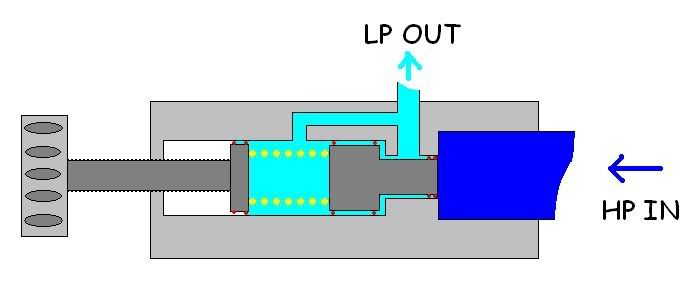
EDIT I did a bit of research, and think I have a basic idea of what is going on in a regulator, and please anyone tell me if my little diagram is right or no, because it would not be hard to replicate...
Posted: Wed Jan 28, 2009 11:15 pm
by frankrede
You could easily build a flow meter, or atleast a device to restrict flow to a safe flow that you could regulate manually.
Posted: Wed Jan 28, 2009 11:25 pm
by sputnick
I'm looking for full on regulation, how hard would that be to build one by hand?
Posted: Wed Jan 28, 2009 11:28 pm
by MrCrowley
Like what frankrede said, if you limit flow you can regulate the pressure. You could even do this by opening a ball valve very slowly for example.
Re: homemade regulators
Posted: Wed Jan 28, 2009 11:31 pm
by Ragnarok
Well, in answer to your question, I've been thinking about these things for a while.
Here's a crude diagram of how a regulator could be built relatively easily.
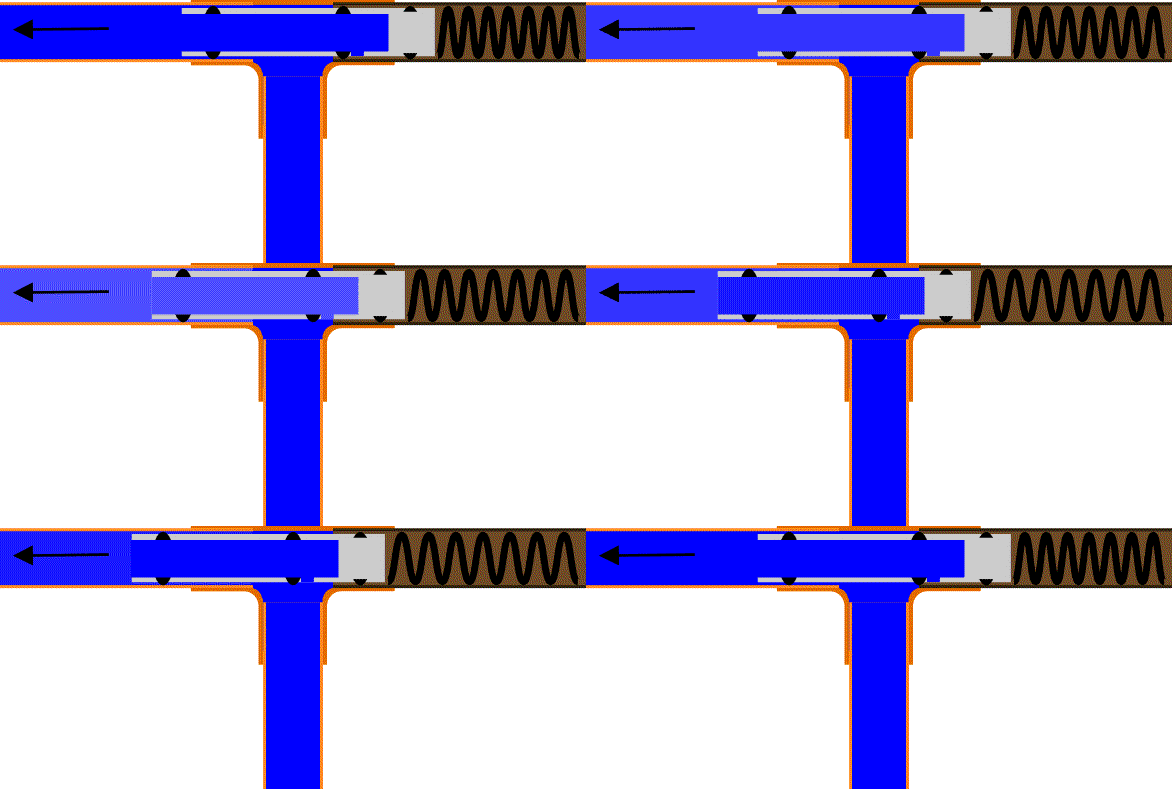
Basically - downstream pressure falls, spring pushes open valve, lets air through until pressure is back up, at which time it closes again. Upstream pressure has no effect on the valve's operation.
I have since refined the concept slightly to improve reliability with the tools and materials I personally have at hand - although the same basic principles are shared.
Posted: Wed Jan 28, 2009 11:50 pm
by rp181
The simplest (and most dangerous) is to have a small orfice, and let the gas fill until desired pressure is reached, then block the orfice. You can easily over pressure though.
Posted: Thu Jan 29, 2009 12:09 am
by inonickname
Just a needle (very low flow valve) with a pressure gauge on the side you're filling. Manually shut it off at the correct pressure. If you wanted to be nifty you could use a digital gauge and have it set up (adjustable) so it close the valve off at the pressure you select. Though on how a store bought reg would work, can't help ya.
Posted: Thu Jan 29, 2009 12:10 am
by sputnick
remember guys, we're talking 3000 psi here, rag, I love your idea, since the pressure is not acting directly against the piston, so springs are easier to adjust... but I imagine it would need to be galvanized not copper for those pressures, and galvanized T's aren't as well cut as your diagram assumes, unless I were to mill out the inside of the nipples attached, (an intriguing thought actually... I will look into that,)
Does anyone know the pressure rating on galvanized steel fittings (typically), because I would rather not have to go with hydraulic fittings, those things are expensive as F***, but I would use them if absolutely need be.
Posted: Thu Jan 29, 2009 12:17 am
by inonickname
Well, it's not galvanized, but this might rest some of your fears on copper:
The copper tube handbook
Scroll down, it has pressure ratings for all variations of copper pipe. Also remember that brazing can wreck the annealing which will lower it's strength, so look into soldering or re-annealing.
Posted: Thu Jan 29, 2009 12:35 am
by sputnick
whoa, so if I am reading this right, For 1/2 inch copper pipe, the pressure rating is about 1000 psi, but the actual burst pressure is 9000?!?!?!? (drawn, K type at room temp) that's incredible... I still think I would feel scared S***less about having a metal tube pressurised to 2000 psi over its listed pressure rating... Also, using smaller pipes might work, thicker walls and less SI's for the P to push on...
Posted: Thu Jan 29, 2009 2:41 am
by ALIHISGREAT
http://www.palmer-pursuit.com/cart/inde ... cts_id=181
the palmer's regs are small and work with HPA.... although they are quite pricey.
Posted: Thu Jan 29, 2009 3:55 am
by tghhs
my mod to rags idea
really crappy animation, i tried but i think u get the picture, (pun not intended, but funny)
not as good as i hoped but my idea is that u fill the back to what pressure u want it to be at
and when the pressure on the left side is the same as on the right it slides back coz of the larger surface area, closing off the inlet ready to be fired. Which slides it open again
and u get the idea
Posted: Thu Jan 29, 2009 7:34 am
by psycix
MrCrowley wrote:Like what frankrede said, if you limit flow you can regulate the pressure. You could even do this by opening a ball valve very slowly for example.
Pushes... (ball valve doesnt open)
Pushes harder....
Even harder push..... (overcomes static friction, ball valve completely opens:
WHOOOSH --- BLAM
Not very safe to do it with a ballvave. I recommend a needle valve.
tghhs
Using air pressure instead of a spring is a good idea indeed. Though "my idea is that u fill the back to what pressure u want it to be at" wont work your way, because of the lower surface area on the back. Maybe keep rag's layout (same surface area's), but with your air-spring.
The air pressure can be adjusted more easily then a spring, and on 3000 psi, you would need one hell of a spring...
Posted: Thu Jan 29, 2009 7:49 am
by Ragnarok
sputnick wrote:but I imagine it would need to be galvanized not copper for those pressures
Possibly, but copper is what my "standard collection of part shapes" that I have around covers, so that's what I did it in.
I would recommend using an air spring for it, and indeed, that's what I'll be doing if I get round to building one - the only reason it shows a mechanical spring is that air springs aren't very obvious in a diagram, and I don't like labelling my animations.
Posted: Thu Jan 29, 2009 9:19 am
by grumpy
if you are using a hpa paintball tank as your air source, the out put is only around 850 psi on a high pressure tank and 450 psi for a low pressure tank.
i realy recomend just buying a reg it will be much safer, this one will handle co2 or hpa quite well.
http://cgi.ebay.com/NEW-PMI-EVIL-DETONA ... .m20.l1116